

Artificial intelligence (AI) is creating a major impact with unprecedented changes across the media and entertainment industry. From AI tools that can influence storylines and contextual advertising to crafting accurate personalization features and innovative tools for data security, discover how the industry is incorporating AI.
What is AI?
- Artificial intelligence (AI) is a wide-ranging branch of computer science concerned with building smart machines capable of performing tasks that typically require human intelligence. (Built In)
- Generative AI (or gen AI) is a type of artificial intelligence that creates original content—such as text, images, video, audio, or software code—based on a user’s prompt or request. (IBM)
- Generative AI refers to deep-learning models that can take raw data — say, all of Wikipedia or the collected works of Rembrandt — and “learn” to generate statistically probable outputs when prompted. (IBM)
- When it comes to generative AI, it is predicted that foundation models will dramatically accelerate AI adoption in enterprise. (IBM)
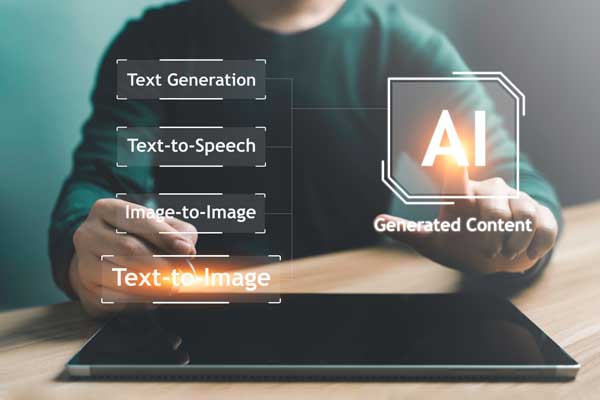
How does AI Work?
A Beginner’s Guide to How AI Works (Science News Today)
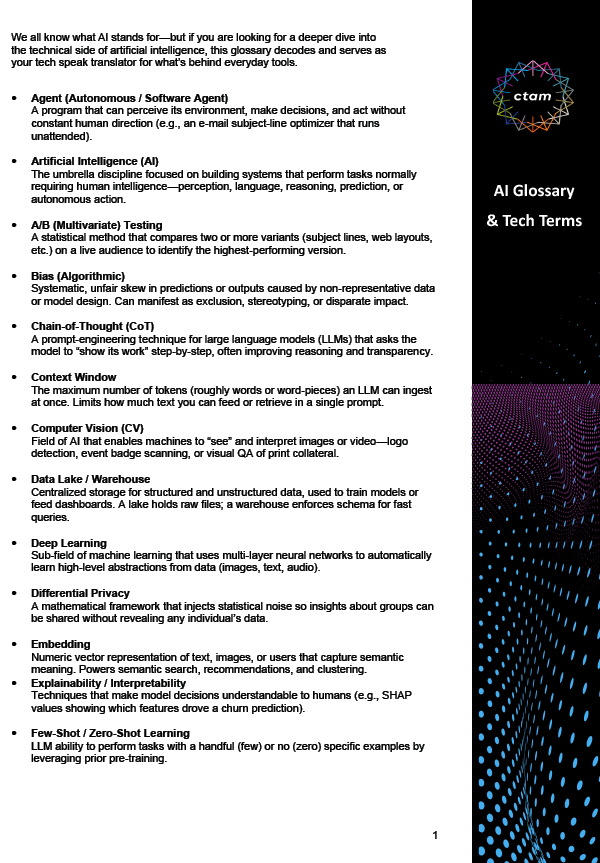
Decoding AI: Your Inside Guide
We all know what AI stands for—but if you are looking for a deeper dive into the technical side of artificial intelligence, this glossary decodes and serves as your tech speak translator for what’s behind everyday tools.
Machine Learning vs. Deep Learning
Machine Learning
- A machine learning algorithm is fed data by a computer and uses statistical techniques to help it “learn” how to get progressively better at a task.
- ML algorithms use historical data as input to predict new output values.
Source: Built In
Deep Learning
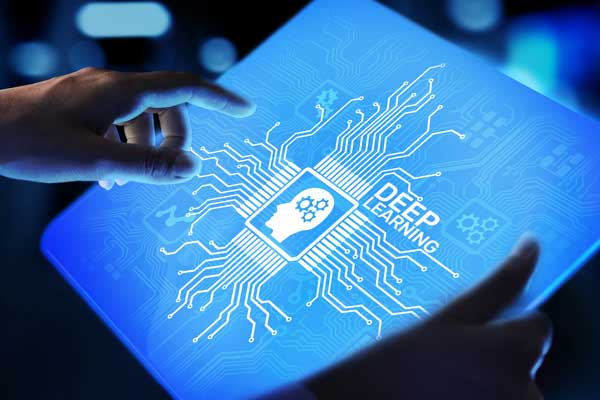
- Deep learning is a method of artificial intelligence (AI) that teaches computers to process data in way that is inspired by the human brain.
- Deep learning models can recognize complex patterns in pictures, text, sounds and other data to produce accurate insights and predictions.
- Deep learning methods can be used to automate tasks that typically require human intelligence, such as describing images or transcribing a sound file into text.
Source: Amazon
Forecasts and Metrics
Top AI Stats Shaping the Near Future
(Hostinger 2026)
-
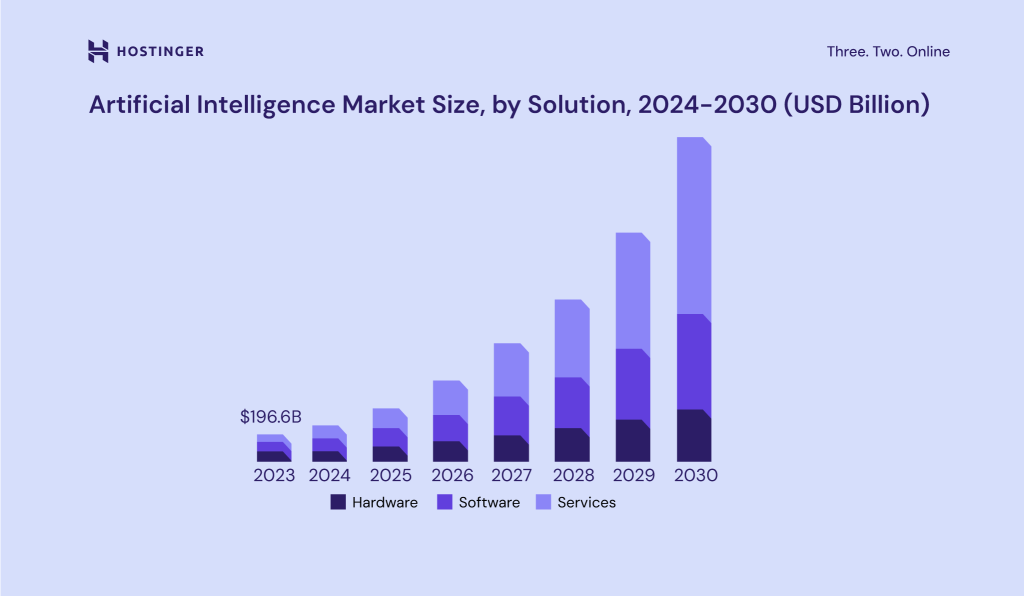
The global AI market is expected to grow annually by 37%. (Hostinger, 2026)
-
By 2030, AI is projected to contribute over $15.7 trillion to the global economy. (Hostinger, 2026)
-
AI is estimated to create 133 million new jobs by the next decade, while almost 40% of all business leaders plan to upskill their employees in the next few years. (Hostinger, 2026)
-
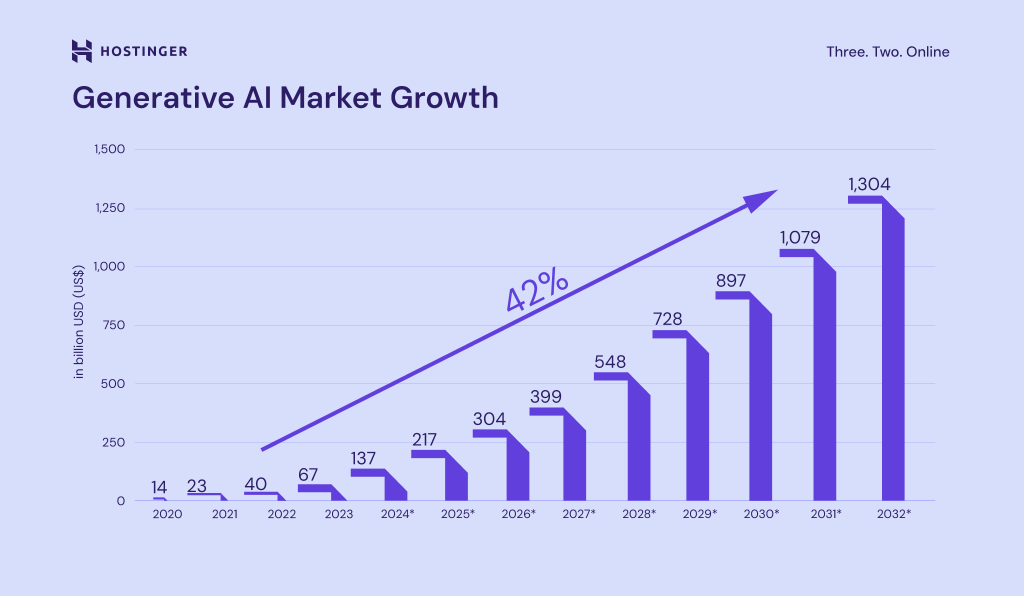
Generative AI leads adoption with 51% of companies utilizing it for content, customer support, and automation, with the market projected to reach $1.3 trillion by 2032. (Hostinger, 2026)
-
Data privacy, security risks and potential bias are the top concerns of AI usage among Gen Z business leaders. (Hostinger, 2026)
-
Businesses allocate up to 20% of their tech budget to AI, and 58% of companies will increase AI investments in 2026. (Hostinger, 2026)
-
Global AI market size is projected to grow from $376 billion in 2026 to over $2 trillion by 2034. (Fortune Business Insights, 2026)
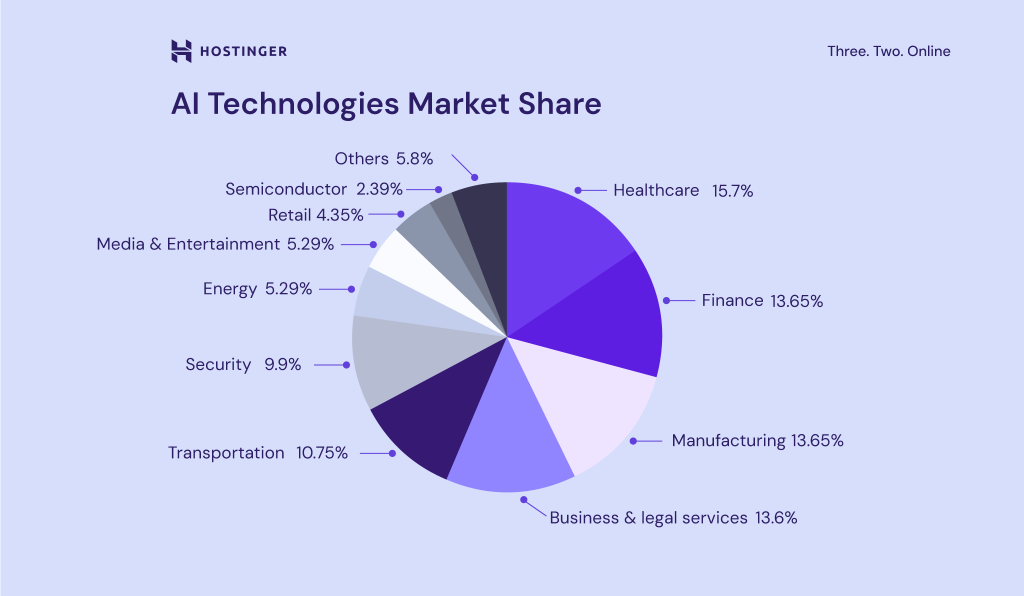
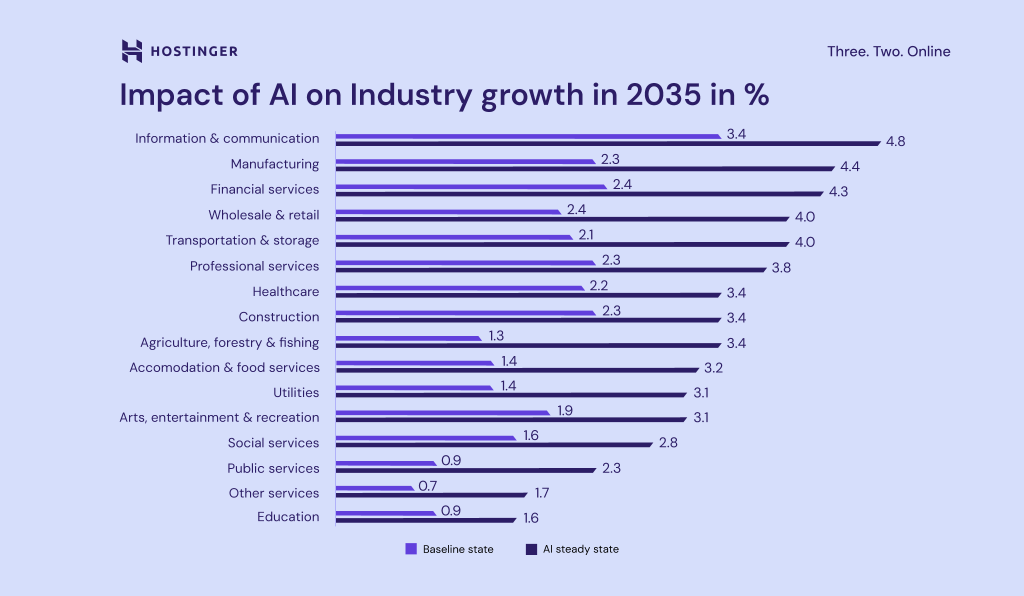
- AI has the potential to boost workforce productivity and industry growth from 1.9% in arts, entertainment and recreation to 3.1% by 2035. (Hostinger, 2024)
Consumer AI Perceptions
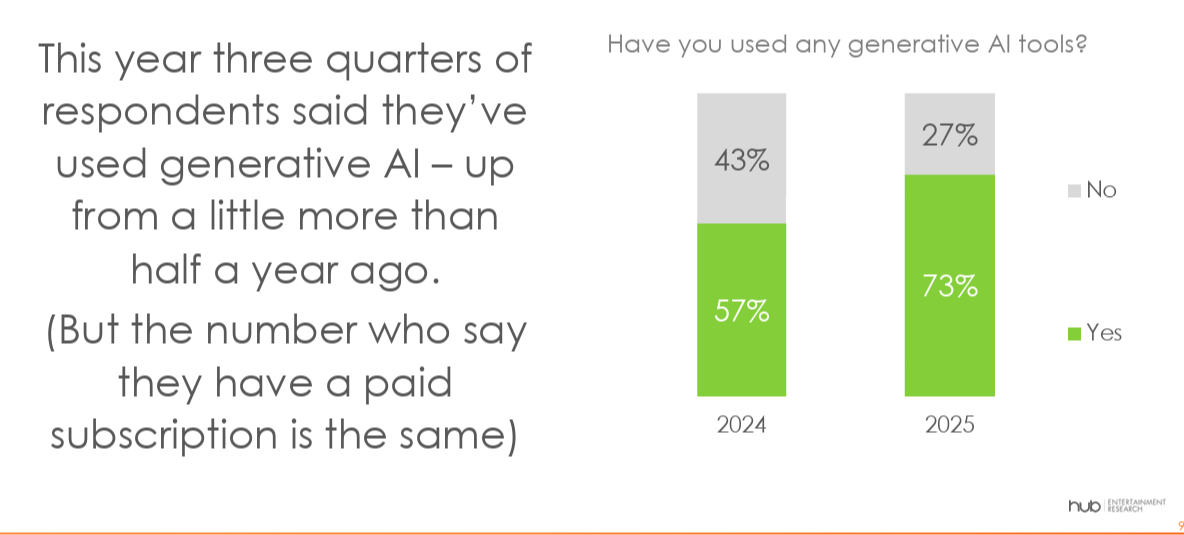
- Consumers increasingly expect artificial intelligence to reshape everyday life as it moves into the mainstream. Nearly three-quarters (73%) are now familiar with generative AI and understand how it works, and adoption has grown significantly compared to just over a year ago (57% in 2025). (Hub Entertainment Research, 2026)
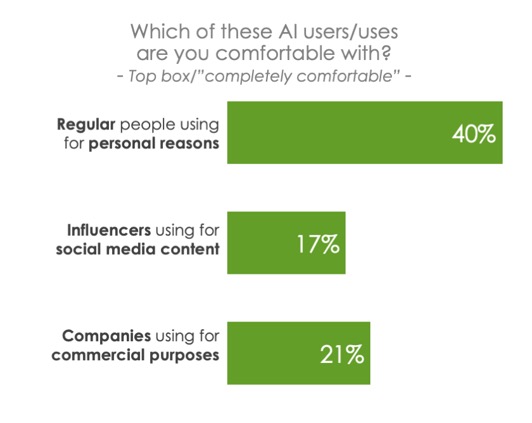
- While 40% say they are “completely comfortable” with AI being used by regular people for personal reasons, that’s roughly twice as many as those who feel equally comfortable with influencers (17%) or companies using AI for commercial purposes (21%). (Hub Entertainment Research, 2026)
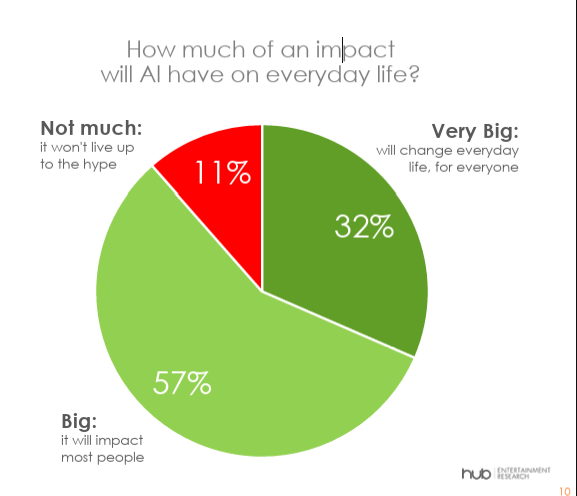
- About 75% say they’re familiar with AI and understand how it works. Even so, about 90% expect AI to cause big changes (and a third think it will change daily life for everyone). (Hub Entertainment, 2026)
- There is a growing concern over being able to distinguish the difference between reality and AI-generated content. (Hub Entertainment, 2026)
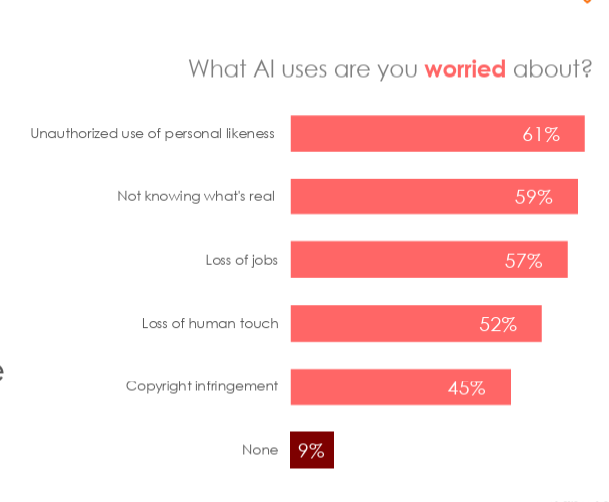
Consumer AI Use
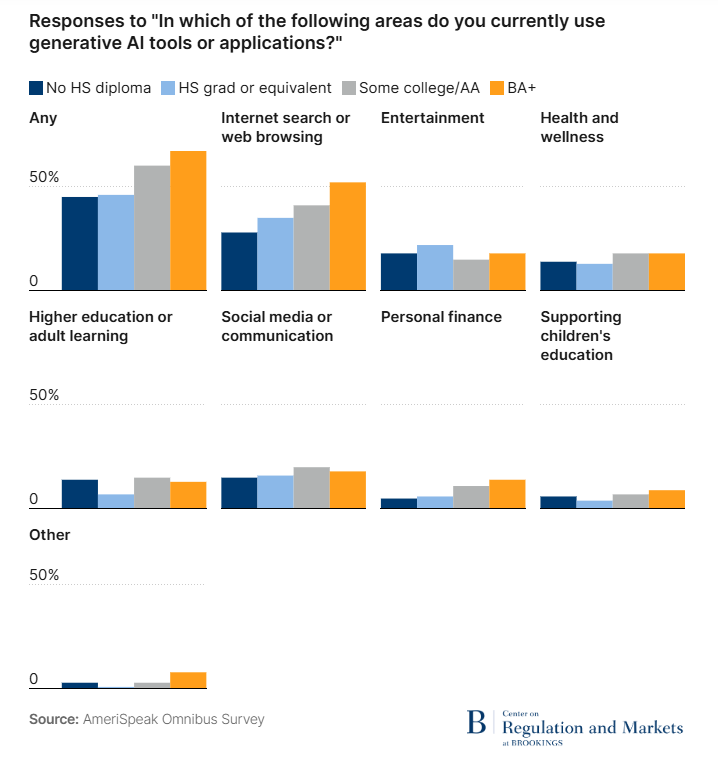
- People are increasingly adopting AI in everyday life and work. A nationwide survey finds that a majority of Americans use generative AI for personal tasks like searching the web or other household needs, while a growing number also report using AI in their professional lives. (Brookings, 2025)
- 57% report using AI for at least one personal use, most of whom use it for internet searches or web browsing (74%). (Brookings, 2025)
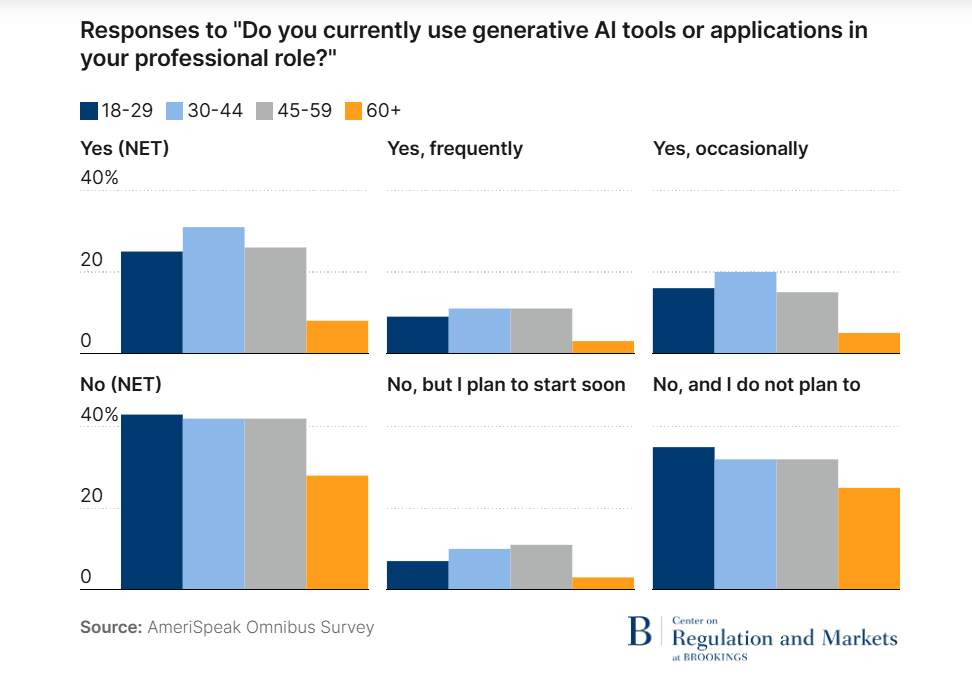
- 21% report using generative AI in their professional role, while usage is greatest among 30-44 year olds (31%), followed by 45-59 (26%), and 18-29 (25%), but falls to 8% for those 60+. (Brookings, 2025).
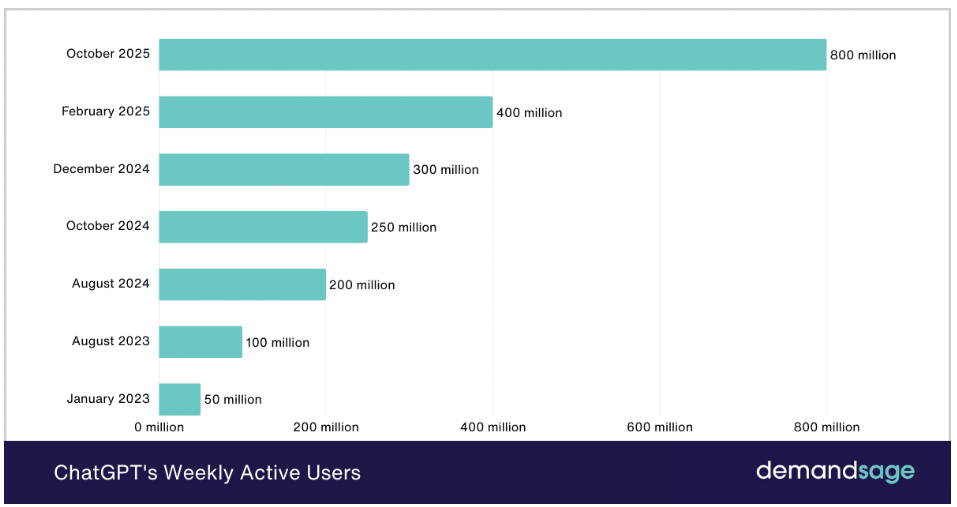
- Globally, ChatGPT weekly active users have reached 800 million, doubling from 400 million in February 2025. (demandsage, 2026)
- An increasing number of everyday consumer products use AI technology, proving how it’s reshaping our world.
Smartphones
Smart Speakers
Smart TVs
Online Shopping
Autonomous Vehicles
Virtual Healthcare Assistants
Streaming Music Services
Fitness Trackers
Banking and Finance
Smart Refrigerators
Wearable Health Monitors
(Science News Today, 2025)
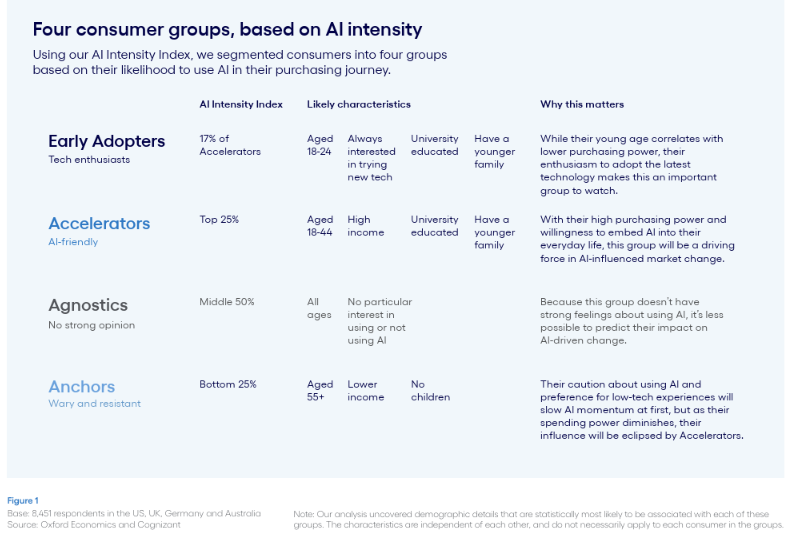
- Consumers who embrace AI could account for up to 55% of spending by 2030, making it critical for businesses to understand the expectations of the AI-powered customer (Cognizant; New minds, new markets, 2025)
- To gauge how AI will reshape consumer behavior and its long-term economic impact, it’s essential to understand how adoption varies across consumers—Early Adopters, Accelerators, Agnostics, and Anchors—and their likelihood to use AI in their purchasing journey. (Cognizant, New minds, new markets, 2025)
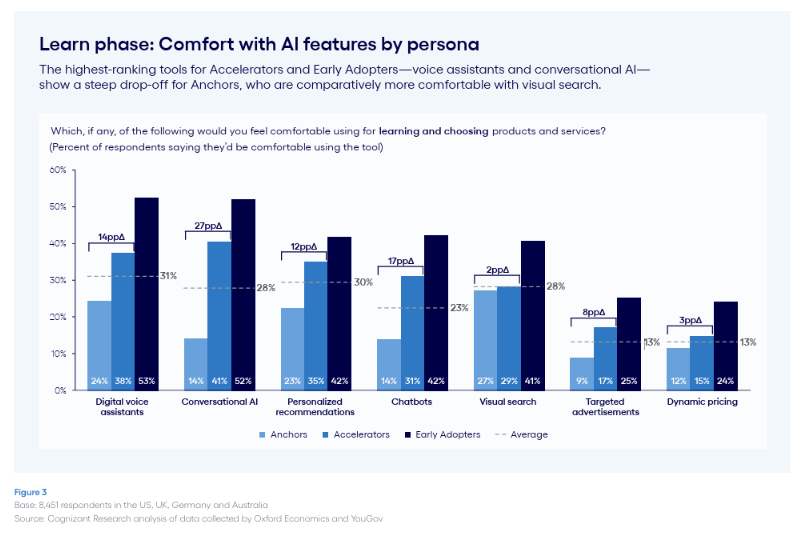
- In a Learning Phase, more than half of Accelerators and Early Adopters are more comfortable in choosing voice assistants and conversational AI. (Cognizant, New minds, new markets, 2025)
- Depending on consumer intensity, the sentiment, interest, and trust varies. About 1/3 of Anchors wouldn’t use any AI tools within the learning phase, preferring human interaction and concerns for accuracy. Visual search does, however, stand out as a middle ground, virtually matching comfort levels of Accelerators and Anchors. (Cognizant, New minds, new markets, 2025)
Source: Cognizant, New minds, new markets, 2025
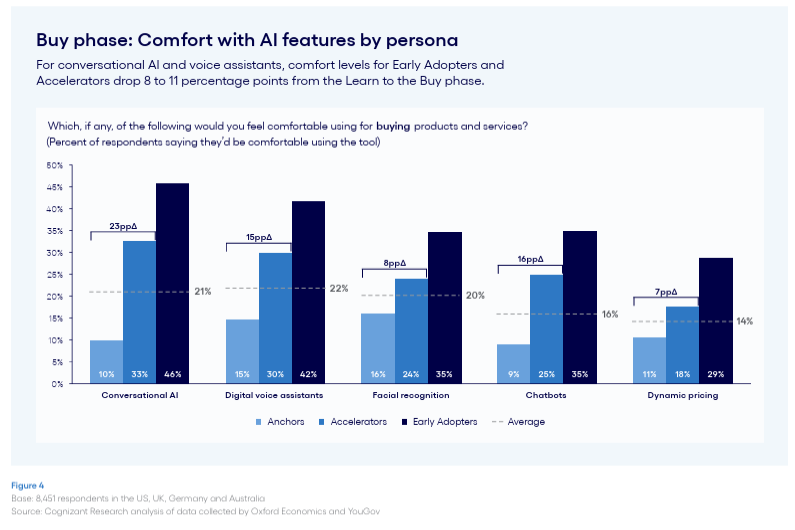
- In the Buy phase, even AI’s most enthusiastic users are cautious. Accelerators’ overall comfort drops from 50% to 33%, and Early Adopters drop from 58% to 34%. (Cognizant, New minds, new markets, 2025)
Source: Cognizant, New minds, new markets, 2025
Read more of Cognizant’s report
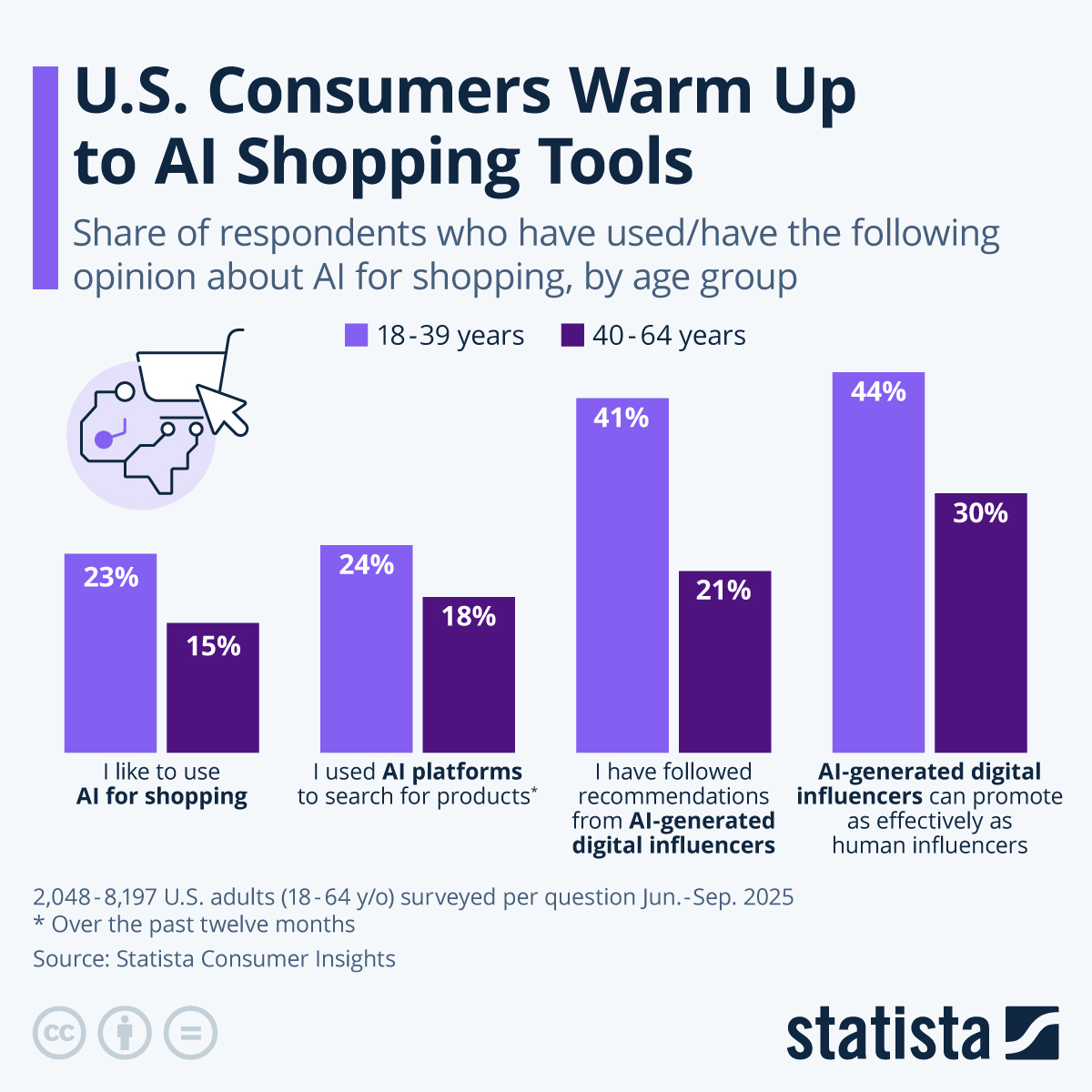
- Approximately 1 in 5 Americans used AI to search for products in the second half of 2025,
with younger adults more interested. (Statista, 2025)
- 17% of consumers are using some form of AI for shopping research. (Cleveland Research Company Consumer Survey, 2025)
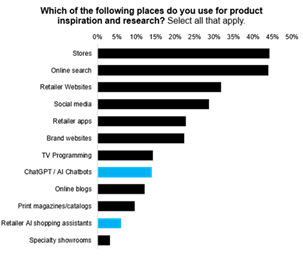
Source: CRC Study 2025 October Study
AI Programs
AI has evolved beyond simple chat tools and into powerful, everyday solutions that support how we work, create, and move through the world. Today’s tools aren’t just reactive—they’re designed to help produce content, generate visuals, stay informed, manage daily tasks, and assist in the office at home, or on the go. With an array of broad capabilities, success starts by identifying the task—then choosing the right AI to execute the job.
Everyday AI Engines
- Top AI Tools and Trends for the Year Ahead (DataNorth, 2025)
- The Best AI Tools for 2026 (SurePrompts, 2026)










AI for Writing
AI writing tools can spark ideas, edit drafts, generate content, and even optimize for SEO—in minutes. But not all tools are created equal. A range of pricing and specialties exist, and the right choice depends on your goals. (Cybernews, 2025)
Marketing

Professionals and Students
General Writing Tool

Large Projects

Paraphrasing, Summarizing

Marketing and SEO

Storywriting for Authors

Freelance and Small Business Writing

Academic Research

AI Detection Avoidance
AI for Drawings / Visuals
As AI continues to surge, so does its role in creative expression—fueling a new wave of powerful art generators transforming how we imagine and create.
- How does AI generate art? (California Learning Resource Network, 2025)
-
Best AI Art Generator Apps (Guidesai, 2025)










Location-Based AI
Google Maps uses location data from smartphones, as well as user-reported data. (Built In)
AI Personal Assistants
- It’s a new era for personal assistants. With AI, PAs work in partnership, monitor and analyze needs, and have the ability to create and complete a range of tasks. (Analytics Insight, 2026)
AI In Media
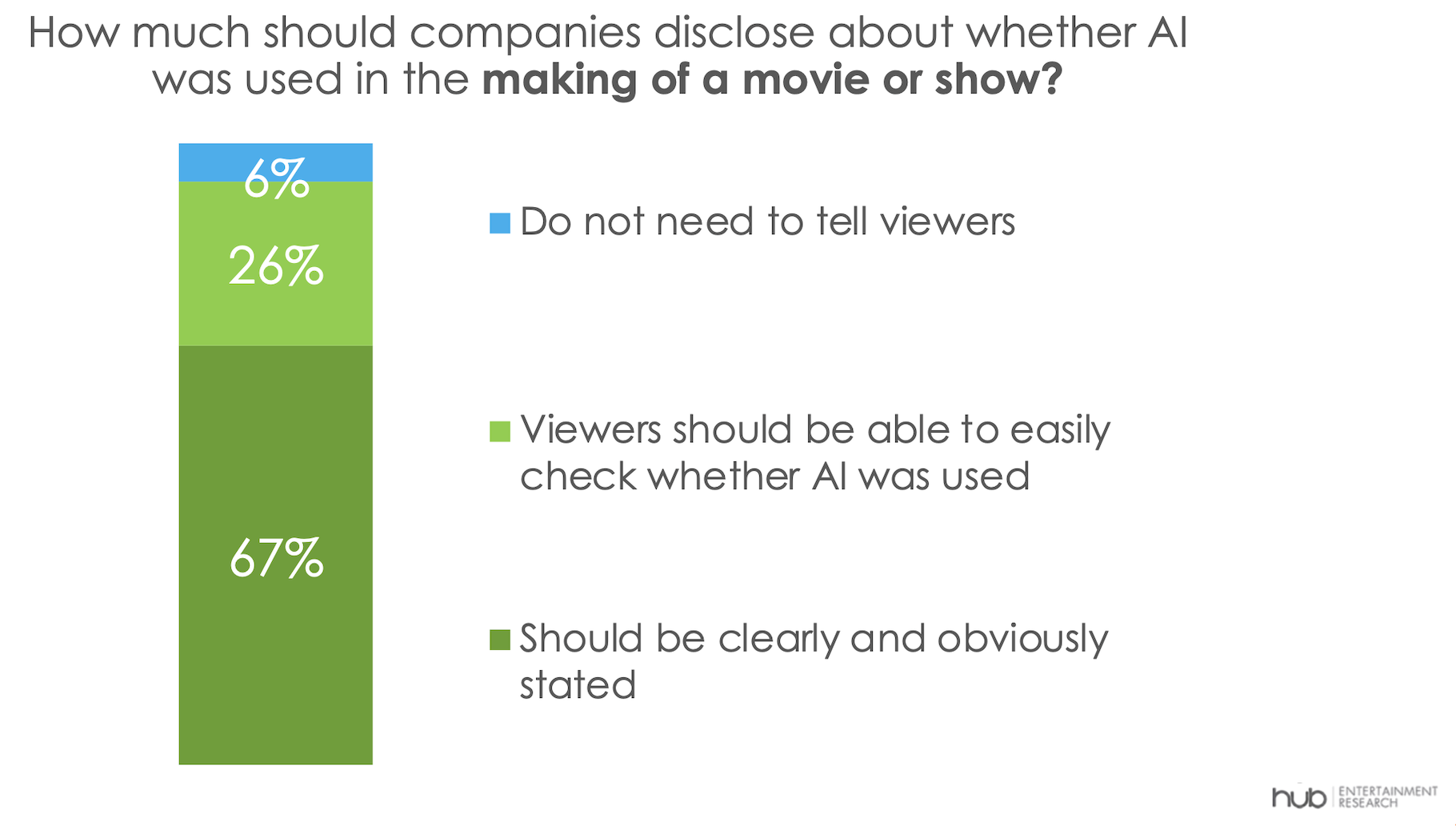
- Two-thirds (67%) of respondents said that any content made with AI should be “clearly and obviously labeled,” and another 26% said there should be an easy way for viewers to check if the title they’re watching contains any AI content. Only 6% said platforms don’t need to inform viewers about the use of AI. (Hub Entertainment Research, 2024)
Media Examples
Case Study | Netflix Recommendations: How Netflix Uses AI, Data Science, And ML

- Netflix AI generates thumbnails by annotating and ranking hundreds of frames taken from a preexisting movie or TV program to determine which thumbnails are most likely to prompt a click from users.
- It foresees how many subscribers it will have in the future. Therefore, it has room to make more technological advances.
- Netflix improves video quality for viewers even during busy viewing times by placing video assets near subscribers in advance.
- Because of Netflix AI, a single Netflix account may be used in two distinct locations, but you will be shown different recommendations in each. This algorithm learns on its own and continues to gather information.
- Netflix uses several machine learning algorithms that evaluate reviews, search terms, similarities, and many more variables. Then, they deliver personalized suggestions to their users.
- Article: Netflix Recommendations: How Netflix Uses AI, Data Science, And ML
AI in Marketing
Marketing
- AI is transforming marketing by shifting how people discover and buy products — moving from traditional search to AI-driven discovery — and forcing brands to optimize for AI visibility while also adapting to AI ‘agents’ that could ultimately make purchasing decisions on behalf of humans. (Harvard Business Review, February 2026)
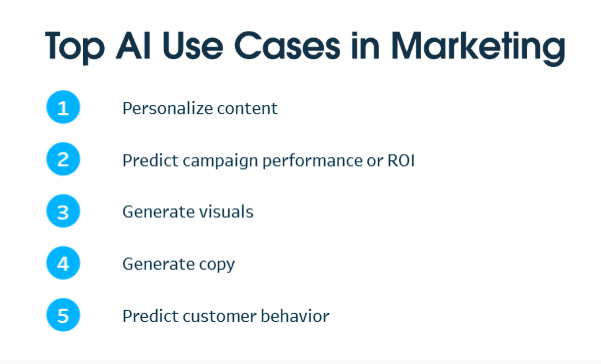
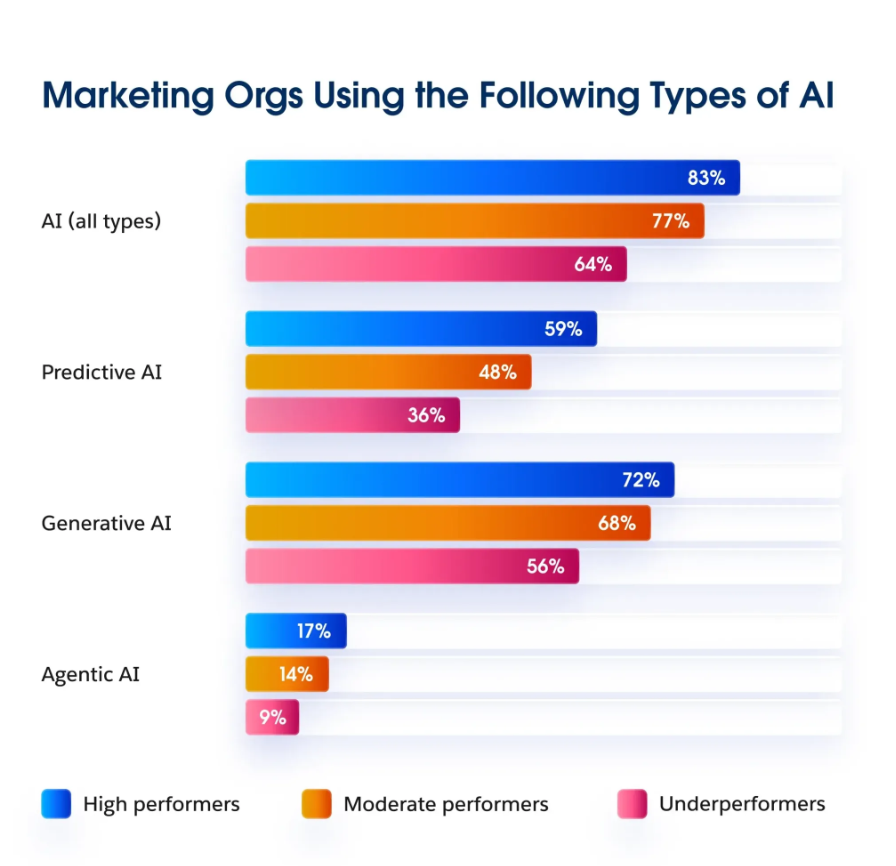
- 75% of marketing organizations now use at least one form of AI—for tasks like content personalization, campaign forecasting, or creative—showing wide brand adoption. (Salesforce Tenth Edition State of Marketing, February 2026)
Source: Salesforce 2026
Source: Salesforce 2026
- Many marketers say greater AI use frees up time for higher-value work, expecting to reclaim up to eight hours per week and redirect it toward more strategic, creative efforts. (Salesforce Tenth Edition State of Marketing, February 2026)
- Thirteen percent of marketers say they currently use agentic AI, and the new technology is rapidly becoming a hallmark of top-performing teams. (Salesforce Tenth Edition State of Marketing, February 2026)
- As brands lay out plans for Agentic AI, marketers face adoption challenges navigating increased existing customer expectations while acquiring new customers is getting harder (Salesforce Tenth Edition State of Marketing, February 2026)
Resources
Decoding AI: Your Inside Guide
We all know what AI stands for—but if you are looking for a deeper dive into the technical side of artificial intelligence, this glossary decodes and serves as your tech speak translator for what’s behind everyday tools.
ChatGPT Cheat Sheet (Hostinger.com)
Gain an introductory level to AI and ChatGPT with guidelines, resources and prompt tools to help with your marketing, web development, SEO and content creation.
What is Artificial Intelligence? Understanding AI and Its Impact on Our Future
Science Today
To understand AI and its uses, it’s important know its origins, components, types, and evolution and what it means for the future.
AI and Entertainment
AI can accelerate creative and technical work, but storytelling and ethical concerns around rights and labor remain crucial. Read more about how AI could transform film and TV production—from script to post—boosting efficiency and expanding who gets to tell stories and how they’re created.
Leveraging the Power of AI: A Guide for Executives
Insight Guide
Gain a comprehensive background on the impact of AI and discover how AI enhanced platforms can reinvent the relationship between your company and customers.